Akhil Bharatiya Shiksha Samagam: How is Education Evolving for the Future?


There's data by ASER that discusses how much of the national conservation on schooling in India has shifted from access toward learning outcomes. One of their household surveys show despite high enrollment rates, the foundational literacy and numeracy levels remain a concern and there is a need to rethink how learning actually happens rather than simply whether students are in school.
In one of the global research it was found that 80% of parents reported improved academic performance among children enrolled in experiential online schooling environments that focus on activity and project based learning rather than lectures and passive listening.
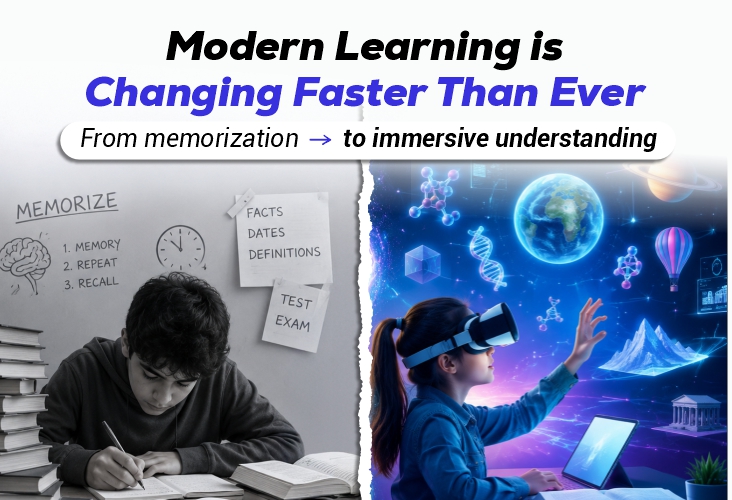
All this data reflects a simple reality: that while traditional education provides structure and broad access, the effectiveness of learning also depends on engagement, participation, and relevance to practical and real life based skills.
As education systems evolve, the challenge is to not shift from traditional education but also incorporate non-traditional methods of teaching as they all are essential for educators, parents, and policymakers.
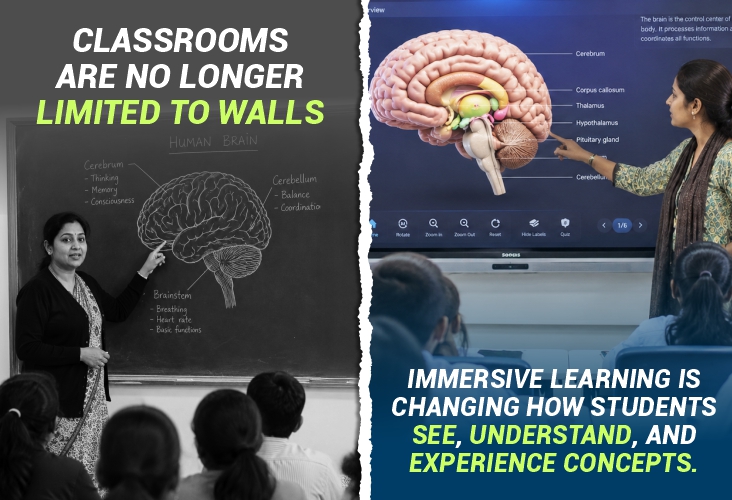
Traditional education has been the conventional classroom-based learning system where teaching is done in a structured environment. There is a fixed curriculum which is designed by education boards and accordingly teachers deliver lectures as per the grades and subjects. This way, learning becomes formal, is scheduled, and is also a standard one for every child. Students move together as a group where everyone learns the same topics at the same time whether they have another pace or a different learning style.

Teachers are the subject experts and they are responsible to complete the syllabus, maintain the classroom discipline, and ensure that students understand the concepts and perform well academically. They guide learning but have tight timelines and curriculum boundaries. Students are passive learners here where they listen, memorize, practice, and perform.
Despite its limitations, traditional education has played a crucial role in shaping generations.
Some of its strengths include:
However, traditional education doesn’t always cater to every child.
Some common challenges include:
These gaps are what led educators to rethink learning and opened the door to non-traditional, more experiential approaches.
Learning that goes beyond the traditional way of education is what is non-traditional education. It can be going beyond the textbooks, going beyond learning the concepts, or beyond just giving exams.
It recognizes the one simple truth: that children don’t all learn the same way and they should not have to.
It was introduced because traditional methods alone were no longer enough to:
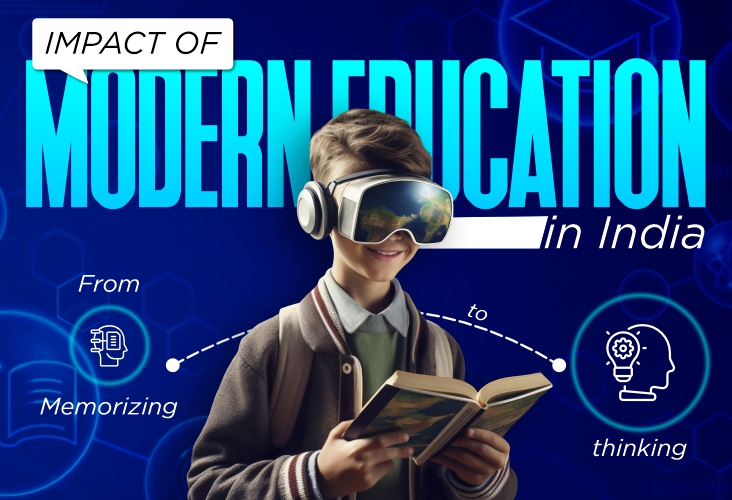
Non-traditional education emerged to bridge this gap. There’s assessments beyond exams also hence non-traditional education do not just rely on tests and marks but have other holistic forms of assessment. The progress is evaluated through projects, presentations, participation, reflection, skill development, problem-solving abilities. This way the child does not just mug up the concepts but understands and learn how to apply those concepts.

Non-traditional education brings several powerful advantages:
| Aspect | Traditional Education | Non-Traditional Education |
|---|---|---|
| Learning Approach | Teacher-centered, instruction-led | Learner-centered, experience-led |
| Curriculum Structure | Fixed syllabus decided in advance | Flexible, adaptive, and evolving |
| Teaching Style | Lectures and explanations | Facilitation, guidance, and exploration |
| Role of Students | Passive listeners and note-takers | Active participants and explorers |
| Learning Materials | Textbooks and notebooks | Play-based kits, digital tools, real-world resources |
| Use of Technology | Limited or optional | Integrated through digital classrooms and platforms |
| Learning Environment | Mostly indoor classrooms | Classrooms, outdoors, and real-life settings |
| Assessment Method | Exams, tests, and grades | Projects, observations, reflections, and skills |
| Focus of Learning | Memorization and completion of syllabus | Understanding, application, and skill-building |
| Pace of Learning | Same pace for all students | Personalized pace based on learner needs |
| Creativity & Curiosity | Limited scope within curriculum | Actively encouraged and nurtured |
| Real-World Connection | Minimal and indirect | Strong, practical, and experiential |
| Emotional Engagement | Often pressure-driven | Joyful, playful, and meaningful |
| Examples in Practice | Traditional classrooms and textbooks | Play-based learning (Jaadui Pitara), digital learning (LumaLearn), experiential learning (ThinkTrail) |
The future of education has to be the sphere where structure, discipline, and foundational learning is there but it also has curiosity, discovery, and joyful exploration.
And this is the exact gap that Mittsure aims to bridge.
Where traditional schooling is not completely replaced but is strengthened by integrating the non-traditional methods thoughtfully. This will help children understand better, engage deeper, and learn more meaningfully.

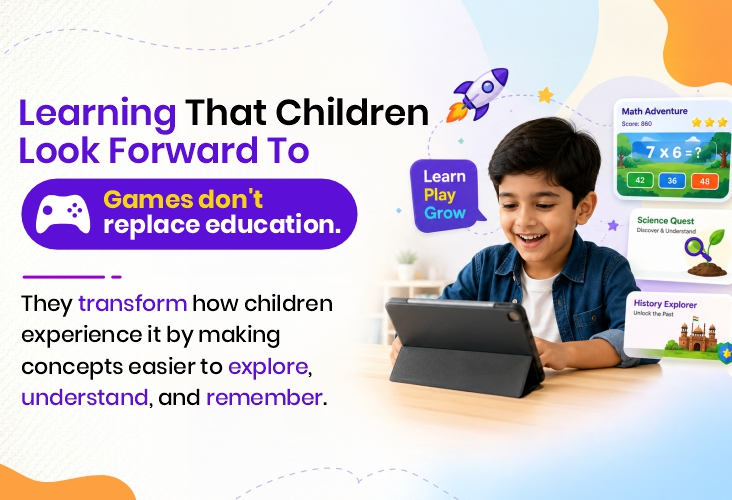
When the foundations are strong in literacy, numeracy, and logical thinking, children enjoy the process better. So Mittsure has designed NCF-Inspired Jaadui Pitara with play-based learning resources covering all the core concepts in a way that feels natural and fun. And children learn by touching, building, sorting, storytelling, and playing.
There’s also LumaLearn that supports digital learning experiences for foundational years while focusing on the Panchakosha Vikas. This way Mittsure extends learning for kids beyond school hours and in a way that feels engaging to them.
With Mittsure’s ThinkTrail, students from Grades 1 to 8 learn through experiential learning where there is exploration, problem-solving, and reflection in the topics. Simply bridging the gap between knowing and doing.
Because when learning makes sense to a child, it stays with them for life.
Traditional education focuses on textbooks, teacher centric, fixed syllabus, face to face instructions, presence matters a lot in this education method.
Non-traditional education also known as Non-conventional education. It refers to the flexible, unstructured learning, which is not rigid to the school structure system. It focuses on vocational training, online courses, community education, and lifelong learning.
Traditional education is teacher focused, follows a fixed format and curriculum with rote learning.
Non-traditional education is student centric, online & hybrid mode, focuses on critical thinking, practical skills, and project based experiences.
The role of Non-traditional education is shifting education from teacher-centric to student-centric engagement.
Traditional education offers structured, disciplined learning with day to day teacher interaction, this is good for foundational learning.
Non-traditional education offers flexibility of offline & hybrid, skill based learning, that fosters creativity and independence of kids.
The disadvantage of traditional education is, its rigidness, rote learning, often focuses on practical & real world skills.
In Non-traditional education, kids often suffer from social isolation, lower engagement and required self-discipline.