Time Management for Children – Tips to Balance Study, Rest & Play


Early childhood care and education (ECCE) has recently become an important focus in India’s education and policy space. What was once an overlooked area is now receiving national attention through government initiatives, parliamentary discussions, large-scale programme rollouts, and newly introduced curriculum frameworks. ECCE is no longer just an academic term, it has become an integral part of the nation’s long-term development vision.
As the government strengthens its emphasis on ECCE, schools must understand this shift and align with the evolving expectations. Making Early Childhood Care and Education accessible, structured, and effortless within school systems is now essential.
Let’s explore why ECCE matters, how the government structures its delivery, and what schools need to know about the latest policy updates up to 2026.
India is a diverse country where every young mind is unique and special. A rigid, one-size-fits-all curriculum can limit a child’s natural curiosity and creativity. ECCE helps reduce learning gaps, improve nutrition outcomes, strengthen early academic foundations, and nurture confident, curious learners.
By focusing on holistic development during the foundational years, ECCE builds language skills, early numeracy, emotional intelligence, and physical coordination that support lifelong learning success.
The early Childhood Care and Education in India is not a single programme but is designed as a multi layered system. This is because the needs of children from birth to six years is not confined to a single thing, instead spans around nutrition, health, emotional well-being, and early learning, which cannot be addressed by one department alone.
Here’s a rough structure on how things flow in India:

What was once considered a welfare-led preschool concept is now a formal, policy-backed foundation of the education system. ECCE now influences admissions planning, infrastructure design, teaching practices, funding alignment, and measurable learning outcomes.
Below is a compiled, fact-based snapshot of all major ECCE updates up to 2026, explained specifically from a school perspective.
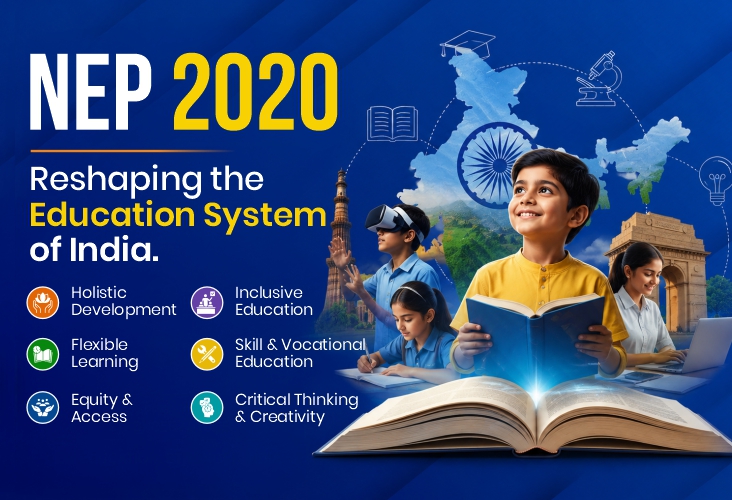
Under the National Education Policy, ECCE is formally placed within the Foundational Stage (ages 3–8).
This means learning before Grade 1 is no longer “optional” or informal, it is recognized education.
Schools are expected to treat pre-primary (Balvatika / preschool) as part of a structured continuum.
The Ministry of Education oversees school-linked ECCE (Balvatikas), while the Ministry of Women and Child Development continues Anganwadi-based ECCE.
For schools, this creates policy legitimacy for running or strengthening ECCE sections.
In Union Budget 2025–26, MWCD received ₹26,889.69 crore, an increase over the previous year.
Out of this, ₹21,960 crore was allocated to Saksham Anganwadi and POSHAN 2.0, both of which include ECCE components.
In Budget 2026–27, MWCD’s allocation rose further to ₹28,183.06 crore.
Allocation for Saksham Anganwadi + POSHAN 2.0 increased to approximately ₹23,100 crore.
Although schools do not receive ECCE funds directly, state governments increasingly align school ECCE initiatives with these centrally funded priorities.
Nearly 2 lakh Anganwadi Centres have been approved for upgradation into Saksham Anganwadis.
These centres now function as:
ECCE activities are no longer optional, they are mandated at upgraded Anganwadis.
Learning kits aligned with the national ECCE curriculum are being supplied.
Anganwadis are increasingly expected to prepare children for school readiness, not just nutrition.
What this means for schools:
Children entering Grade 1 from Anganwadis are expected to be more school-ready, raising the bar for early-grade teaching quality.
A national ECCE curriculum for ages 0–6 is now in implementation.
The curriculum focuses on:
Formal textbooks, exams, and worksheets are discouraged.
Learning is play-based, experiential, and language-rich.
Teacher and Anganwadi training modules are being aligned to this framework.
What this means for schools:
Schools running pre-primary sections must align with developmentally appropriate, play-based pedagogy not mini-Class 1 teaching.
Balvatikas are now formally recognised as school-based ECCE units.
They serve children aged 3–6 years.
Their role is clearly defined:
States are recruiting and training dedicated ECCE educators for Balvatikas.
What this means for schools:
Running Balvatikas is no longer an informal arrangement, it is a policy-supported expansion area for schools.
Anganwadi workers are officially recognised as ECCE functionaries, not just nutrition workers.
ECCE teacher training now emphasises:
States are hiring specialised ECCE educators for schools.
Supervisory roles focus more on mentoring than inspection.
Continuous professional development is encouraged.
What this means for schools:
Schools must invest in ECCE-specific teacher skills, not rely on primary-school methods for young children.
ECCE is fully integrated into Mission POSHAN 2.0.
Nutrition is recognised as a foundation for learning outcomes.
Growth monitoring data informs early interventions.
Parent counselling is part of ECCE delivery.
Early learning is now viewed as a tool to reduce stunting and learning gaps.
What this means for schools:
Schools are increasingly expected to engage parents and support children’s holistic development, not just academics.
ECCE delivery is tracked through platforms like Poshan Tracker.
Data includes:
Information flows from grassroots to national dashboards.
Policy reviews now rely on real-time data.
Outcomes matter more than enrollment numbers.
What this means for schools:
Schools that document ECCE outcomes and child progress are better aligned with government expectations and reviews.
Since ECCE has become a more relevant and outcome-driven part of school, the focus of schools must be placed here too. Foundational learning has to shift from completing the early academic curriculum to meaningful early learning. The ECCE Policy expectations are clear that classrooms need to be play-based learning, developmentally appropriate, and aligned with the new updates in the Foundational Stage without adding complexity for teachers.

This is where Mittsure supports schools in a practical, classroom-ready way.
With our LumaLearn, schools get structured, the NEP-aligned early learning experiences help children build strong language, thinking, and readiness skills. Teachers do not have to design activities or build everything from scratch, and they can focus on delivering engaging learning confidently.
You can know more about Mittsure’s LumaLearn here:
Similarly, Mittsure’s Jaadui Pitara is also NCF Inspired, making ECCE classrooms better with hands-on, play-based materials that support language, numeracy, and socio-emotional development. Learning happens through exploration and interaction, exactly as national ECCE guidelines expect.
For schools, adopting LumaLearn and Jaadui Pitara is not that they will be adding new programmes. It’s about making ECCE work better: stronger engagement, smoother transition to Grade 1, supported teachers, and visible learning outcomes.
In the evolving ECCE landscape, schools that invest in the right early learning resources will set the standard. With Mittsure, schools can align with policy, improve classroom practice, and give children the strong start they deserve, simply and effectively.
Under the National Education Policy 2020, ECCE is formally included in the Foundational Stage (ages 3–8), covering 3 years of pre-school plus Grades 1 and 2. It mandates play-based, activity-driven learning instead of early formal academics.
ECCE is broadly divided into:
0–3 years (care and early stimulation),
3–6 years (play-based pre-school learning), and
Transition to Grade 1 (school readiness and foundational skills).
According to the National Education Policy 2020, ECCE focuses on holistic development, language, early numeracy, cognitive, physical, and socio-emotional growth, through experiential and play-based learning.
ECCE provides structured early learning aligned with education policy, while daycare primarily offers supervision and basic care. ECCE builds school readiness; daycare focuses on safety and routine care.