Time Management for Children – Tips to Balance Study, Rest & Play


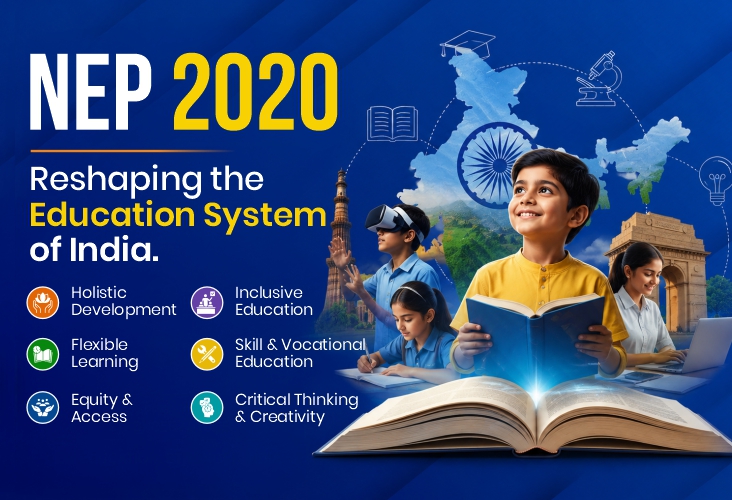
Over the last few years, NCERT has been revisiting the structure, presentation, and depth of content in middle school education, guided by the National Education Policy (NEP) 2020 and the National Curriculum Framework for School Education (NCF-SE 2023).
Rather than replacing the entire syllabus, the focus of these revisions has been on rationalising content, reorganising chapters, and improving conceptual clarity across subjects. This includes rethinking how topics are introduced, how historical narratives are framed, and how learners engage with scientific and mathematical concepts.
As schools plan their academic resources for upcoming sessions, it becomes important to distinguish between what has structurally changed, what has been reframed, and what continues unchanged within the curriculum.
This blog offers a subject-wise explanation of these confirmed shifts, based on official curriculum frameworks and NCERT’s stated directions, helping schools make informed decisions without relying on assumptions or incomplete information.
NCERT’s revised Social Science textbooks for middle school show three concrete shifts:
Detailed political history of the Delhi Sultanate and Mughal period has been reduced, especially in Class 7. Earlier chapter structures were focusing heavily on:
Now they have have been shortened or reframed in some parts and content is presented through broader historical themes
Now focus is placed on:
The Mughal period has not been fully removed, but its depth and political detail have been reduced, and it is no longer treated as a standalone, ruler-centric narrative in the same way as earlier editions.

History, Geography, Civics, and Economics are now presented in a more connected format. Now chapters are designed to:

Strict chronological storytelling has been reduced and greater emphasis is laid on
“How societies functioned”
“Why changes occurred”
Interpretation of topics rather than recalling the facts
Teachers must explain history conceptually, not as timelines alone
Teaching now requires clear sequencing and flow
Teachers benefit from structured explanations and guiding questions
Textbooks need to reflect the thematic progression, not just chapter coverage.
Textbooks must offer:

1. Core topics remain largely the same
However, specific portions have been refined or reorganised.
2. Emphasis has shifted from: Definition-heavy learning to
3. Explanation through observation and activity
Key visible changes include Fewer purely theoretical paragraphs and more of

Teachers need books that:
Mittsure Science books:

Mathematics content continues to include:
However, NCERT textbooks now show:

While the syllabus itself has not undergone drastic change, presentation, structure, and emphasis have evolved. This directly affects how textbooks function in the classroom. Schools today need books that:
Many schools still use:
Older editions aligned to pre-revision NCERT
Some books are no longer required that comes with:
Keeping these curriculum developments in mind, Mittsure has:
The goal has been simple:
to help schools transition smoothly, without disrupting teaching or learning.
The CBSE curriculum of class 6-8 is designed by NCERT to provide activity & fun based learning, focusing on main subjects like mathematics, science, social science and other second languages (Hindi, Sanskrit, Regional).
CBSE grading system for middle school is:
| Grade | Marks Range (%) | Grade Point |
|---|---|---|
| A1 | 91–100 | 10 |
| A2 | 81–90 | 9 |
| B1 | 71–80 | 8 |
| B2 | 61–70 | 7 |
The 4 type of CBSE curriculum structure:
4C’s of the CBSE curriculum: