Is Artificial Intelligence (AI) a Boon or Bane For The Children?


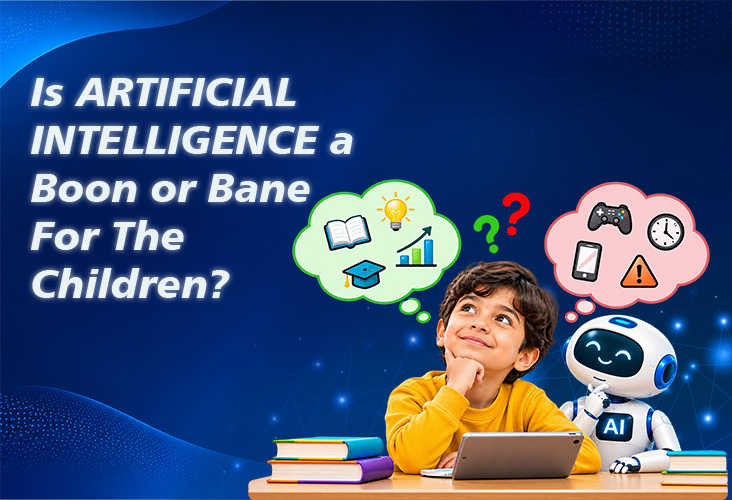
Today’s children are growing up in a world with quick answers to every question that pops in their mind. With the advent of Artificial Intelligence (AI), voice assistants answer before a child opens a book, chatbots help with their homework, and applications make them learn according to their pace. AI is no longer a futuristic idea; it is already part of the classroom, the playground, and the living room.
AI promises personalised learning, instant doubt-solving, and access to knowledge that was once out of reach for many children. However, it raises some serious questions: Are children losing the habit of thinking and finding answers on their own? Is convenience gradually replacing curiosity? Are children being exposed to unsafe content, screen addiction or privacy risks? So, is AI a boon that will shape brighter minds, or a bane that quietly weakens them? The truth lies somewhere in between, and it depends largely on how we guide children to use it.
In this comprehensive post, we will explore both sides and understand how parents and teachers can help children make the most of AI without falling into its traps, but before that let’s first have a look at what AI is and how does it work?
Artificial Intelligence (AI) is a field of computer science that focuses on performing tasks that usually requires human intelligence, like understanding language, solving problems, recognizing images, making decisions, and learning from experience.
AI learns from large amounts of patterns, such as texts, images, numbers and audios, and then uses these patterns to handle new inputs like answering a question or identifying a photo.
AI is mainly based on these 3 types of learning:
Machine learning: Learns patterns from data (spam filters, recommendations)
Deep learning: Many-layered neural networks (face recognition, speech)
Generative AI: Creates new text, images, or audio (chatbots like me, image generators)
Large language models (LLMs): Trained on huge amounts of text to predict the next word, which, at scale, lets them write, explain, translate, and reason
Here are some of the most common pros of AI:
AI converts difficult concepts into simpler explanations and lets each child learn at their own pace. For instance, a child who needs more practice with varied explanations get customized lesson plans to suit their learning styles. AI analyses a student’s strengths and weaknesses and creates personalized content tailored to fit their learning pace.
AI is also helpful in offering homework support to students. If a student gets stuck at a question while doing their homework, AI provides step-by-step explanation rather than direct answers.
Traditionally, a student has to wait for another day if they have a doubt while studying. But with the introduction of AI, a child can simply ask any query to AI at any time of the day and get the answers quickly, and this is how Artificial Intelligence is redefining learning for children.
AI offers improved accessibility to every student. Text-to-speech, speech-to-text and language translations help children study with learning differences.
AI saves a lot of commute time to tuition centres and offers quick answers, even at wee hours of the day.
Let’s have a look at the cons of AI:
Over-reliance on AI can reduce critical thinking, weaken cognitive skills, hamper creativity and lessen independent thoughts.
Some challenges of using AI are that platforms collect user data and may process it, raising privacy risks and concerns about student confidentiality.
Too much usage of AI can increase screen time for children, causing vision and mental health issues.
AI is not always accurate and might share some misleading information, requiring strict fact checking.
All in all, whether the role of Artificial Intelligence (AI) is a boon or a bane for children depends on how it is used. AI has the potential to help children learn personalised lessons, understand difficult concepts in simple ways, and create curiosity through interactive tools. When used appropriately, AI can make learning more engaging and accessible; but over-dependence on AI can weaken critical thinking, creativity, and problem-solving, and AI can never replace the warmth of human interaction, play, and guidance from parents and teachers.
Therefore, the only way forward is balance. Parents and teachers should guide children in using AI as an add-on and not as a shortcut. You can try ThinkTrail, an interactive textbook with an added dose of 3D, AR, and AI content. Every topic in this book open up to videos, animations, and real-world explanations to make difficult concepts a breeze to understand.
Make sure to set healthy limits, encourage children to think for themselves, and teach them to question what they see online as it will go a long way in making AI a boon for them. Remember, with mindful supervision, it can become a boon that helps children grow smarter, creative, and more confident.
Whether AI is a boon or bane for children totally depends on how it is used. When children use AI for understanding concepts, practising skills or supporting curiosity, it is a boon. However, when children replace their own thinking, effort and creativity with AI, it becomes a bane.
AI explains complex topics in simpler language, adapt to a child’s learning pace, offer instant practice questions, is available 24*7 and make learning more interactive. It also supports curiosity by answering the endless “whys” that children ask, which keeps them engaged and encouraged.
The main risks of AI includes over-dependence, security concerns, reduced critical thinking, exposure to age-inappropriate content, increased screen time and inaccurate information. Additionally, children may copy answers instead of understanding them, which weakens problem-solving and creativity over time.
Set screen-time limit, supervise AI content, and choose child-friendly tools. Moreover, encourage children to try the problem first and then use AI to check or deepen their understanding.