Akhil Bharatiya Shiksha Samagam: How is Education Evolving for the Future?


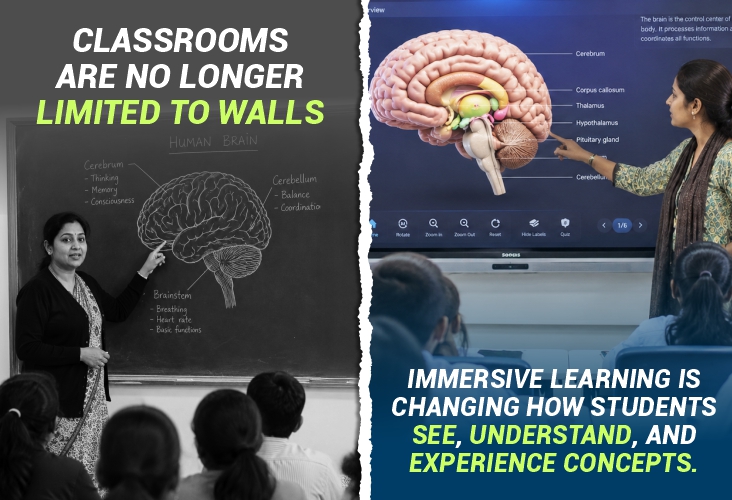
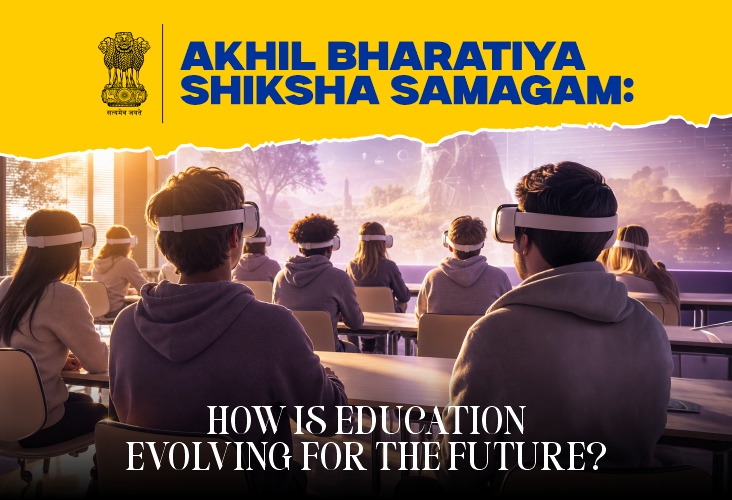
The VR education market reached $21.13 billion in 2024 and is expanding to $188.68 billion by 2035 at a 22.02% CAGR. There’s another estimation that it might hit $8.11 billion in 2026 and then grow to $47.98 billion by 2032 with a 34.41% CAGR. The major pushers being K12, higher education, and corporate training.
VR creates interactive simulations for fields like medicine, engineering, and history, allowing safe practice without real-world risks or costs. It supports personalized learning, aids students with disabilities, and enables virtual field trips to remote locations. Studies show it improves retention through experiential engagement, with 90% of educators viewing it as effective for differentiated instruction.
The future of VR Education looks promising and Schools are understanding how it can help make education experiential and immersive.
A student reading about the solar system in a textbook is one thing, But a student being able to rotate planets in 3D and visually experience how the universe works, is another. Here, VR can change learning completely.
And this is exactly where education is heading towards!
There’s Augmented Reality, Virtual Reality, 3D visualization, interactive simulations, and Ai in education being adopted by the schools across the world for an immersive educational experience to students. That highlights further that the future of education is no longer just delivering information where students grasp it better, but of making students experience the concepts by themselves.
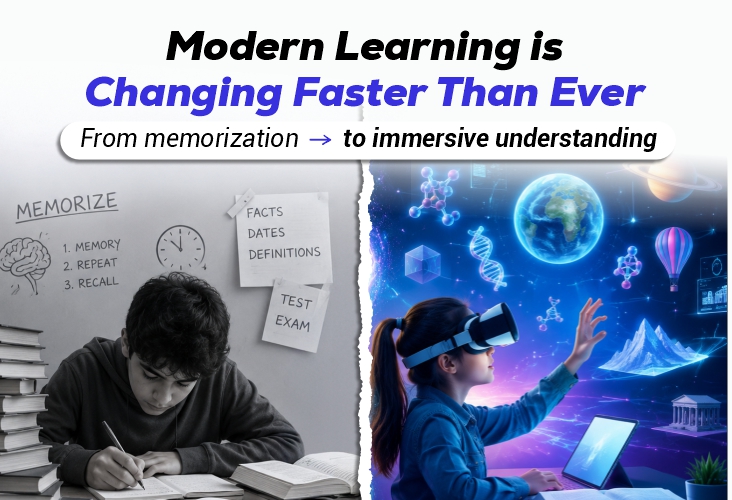
This helps students in understanding the concepts better rather than memorizing it for the exams.
So introducing immersive learning in schools is important to transform education. And this does not mean replacing teachers or textbooks but by making concepts more visual, interactive, experiential, and easier to understand deeply.
Consider this blog as the ultimate guide to how your schools can build immersive learning efficiently and let your students be an integral part of the future of VR Education.
The future of education cannot solely rely on textbooks now. It is now being shaped by artificial intelligence, augmented reality in education, immersive learning, visual-first teaching, personalized education, experiential classrooms, etc.
The focus of making students memorize the concept has completely shifted to students understanding and grasping the concepts in depth. The difference is mainly because there's an overflow of information and everything at one search away. So the need to rote learn the concepts is no longer required and now what students should know is the ability to understand and apply the concepts better.
So the current trends shaping the future of education today are centered around making learning interactive, experience-driven, skill-focused, and visually engaging.
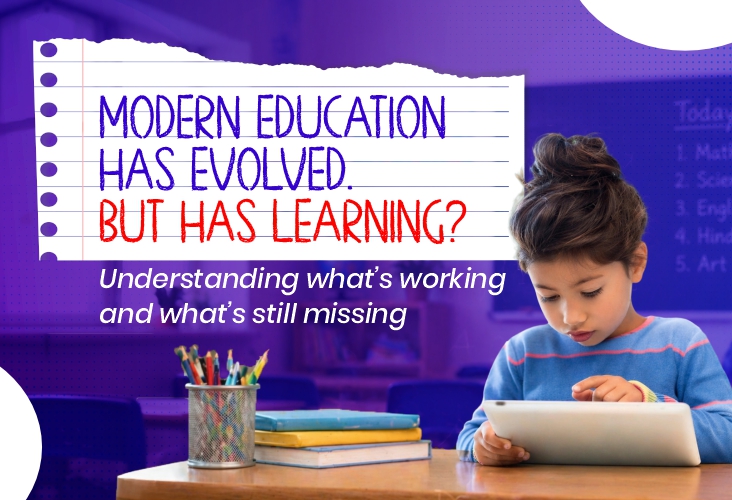
Education has been evolving rapidly with new blackboards shifting to smart classrooms, homeworks to digital resources and online learning platforms, manual teaching planning and lecturing to AI-powered lessons with teaching aids too. All of this has resulted in unlimited access to information. So students can access more knowledge in a few seconds than previous generations could access in days. And despite all these advancements, one major problem somehow still exists…
That even though students are consuming more information than ever… They are understanding things less deeply.
Which is becoming one of the biggest gaps in modern education.
Students are able to access concepts faster, but struggle to experience them. For example, they might know how the solar system works, but might still struggle to visualize the planetary movement, spatial relationships, or how gravity actually behaves.
Learning has shifted to becoming information-heavy but experience-light. Today students can grasp information from anywhere. There are PDFs, videos, online platforms, notes, recorded lectures, practice apps, and AI-generated explanations everywhere. But more information simply does not mean that kids have better learning.
On the contrary, it is making kids accustomed to excessive passive consumption that sometimes tends to reduce curiosity, independent thinking, deep focus, and conceptual retention.
As students often move quickly from one topic to another without the need to fully interact with one concept deeply. This ends up creating a shallow understanding of topics, lesser ability to apply them, and difficulty in solving unfamiliar problems.
So The Gap Between Learning & Application Still Exists.
Because students are able to define concepts, explain the theories, and memorize textbook answers. Yet struggle when they face any real-world scenarios, logic-based questions, application-oriented tasks, or any unfamiliar problem-solving situations.
This mainly happens because information is being delivered but concepts are not always being experienced.
The reason why education systems should shift toward experiential learning, competency-based education, immersive learning, and application-focused teaching.
The future classrooms cannot remain passive!
And this does not mean replacing textbooks or teachers, but actually strengthening the understanding of the concept, participation, engagement, and application-based learning.
VR delivers 76% higher learning effectiveness, 4x faster training, and 275% confidence boosts, making it essential for future-ready curricula. In India, accelerating VR use transforms engagement, aligning with NEP 2020's experiential learning goals.
More schools are integrating VR for STEM and skill training, with projections of half of Indian schools adopting AR/VR by 2027, fueled by government pushes for digital equity. Global trends show VR reducing distractions 4x over e-learning and boosting focus 1.5x versus classrooms, per 2026 PwC data.
Schools must align with VR education amid explosive 2026 growth, as the market surges from $22.16 billion in 2025 to $31.11 billion this year at a 40.4% CAGR, driven by immersive tools for hybrid learning. Recent initiatives like IIT Guwahati's Gyandhara VR metaverse platform and rising Indian school adoption from 7% to 38% since 2021 underscore its urgency for competitive edge.
At Mittsure, we make this possible for schools to build an immersive learning experience for their students.
With our ThinkTrail Books, students do not just get to study concepts but actually experience them.
Because it has AR enabled books where kids can scan a concept and see it live instead of just reading and imagining. There’s 3D visualization that can be accessed from anywhere, giving students a chance to interact with the concepts in a meaningful way and cherish the immersive learning experiences to keep at pace with what the future holds for them.
So instead of only reading about planets, scientific systems, geometry, human anatomy, or complex processes, students actually interact with the topics. This makes their learning more engaging, more memorable, and easier to understand.
It’s time your schools take the shift and secure your students as per the future of VR education.
VR education uses immersive technologies like Virtual Reality and Augmented Reality where students get to experience concepts by visually looking through it and interacting with it rather than just reading it in words and imagining accordingly.
Immersive learning improves concept clarity, engagement, memory retention, and application-based understanding by making students actively interact with concepts.
No, VR education is designed to support teachers and strengthen classroom learning by making difficult concepts easier to visualize and understand.
Because modern students learn better through interactive and visual experiences, while future education is moving toward skill-based and experiential learning.
VR helps students understand abstract concepts better, stay more engaged, improve focus, and apply knowledge more confidently in real-world situations.
Yes, immersive and visual learning often improves understanding, retention, and problem-solving ability, which can positively impact overall academic performance.
Yes, experiential and competency-based learning are key focuses of NEP 2020, making immersive education highly relevant for modern classrooms.
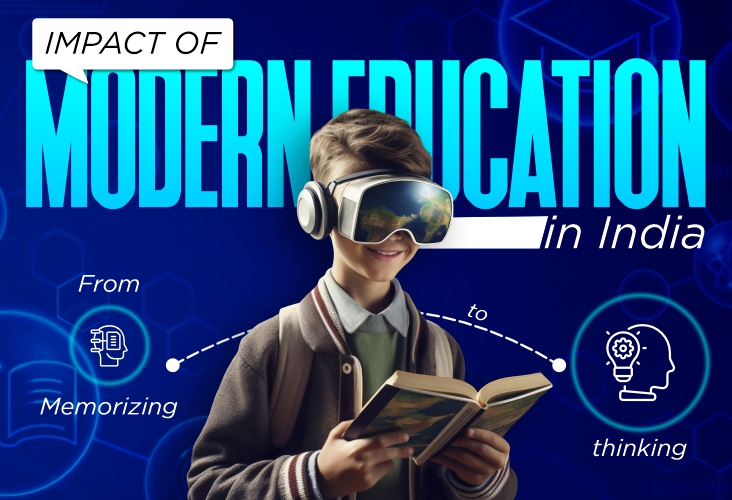
Because education is shifting from memorization-based learning toward deeper understanding, real-world application, and experience-driven learning models.